
Welcome to Sociology at Reigate College.
My name is Katya Pudar and I’m the course leader for Sociology A Level. I’m looking forward to meeting you in person in September, but before you formally enrol onto the course, we’d like you to spend some time over the coming months to complete a series of tasks and activities.
Many of you will be new to Sociology as a subject so it’s really important you’re fully prepared before you start the A Level course. The activities below are a great way to find out more about what’s involved in studying Sociology, so please work your way through them and be prepared to discuss what you’ve learnt when we meet in September.
The tasks are organised in three distinct steps and should all be completed by Choices Day on 25 August 2026. This is to give you the best insight into what the courses will be like and/or help prepare you for them.
Please note, some Course Leaders (for example for Music) may release their tasks earlier, as they may form part of the College’s audition process. If this applies to you, you’ll be notified separately.
New Starters Course Tasks and Activities
| Release date | Suggested Completion Dates | |
| Explore your Subject | 1 June | 1 July |
| Get Going | 1 June | 1 August |
| Aim High | 1 June | 1 September |
Key Concepts in Sociology
The idea of culture is very important to sociologists. Culture is commonly defined as the way of life of a social group. More specifically, the term refers to ‘patterns of belief, values, attitudes, expectations, ways of thinking, feeling and so on’ which people use to make sense of their social worlds (Billington et al. 1998).
Some sociologists argue that culture also consists of customs and rituals, norms of behaviour, statuses and roles, language, symbols, art and material goods – the entire way in which a society expresses itself. Culture brings people together because it is shared and taken for granted.
Values are widely held beliefs that something is worthwhile and desirable; they are what we consider to be good and important. For example, most societies place a high value on human life. Our values shape our norms, which are the specific rules of behaviour and they govern all aspects of human action. For example, valuing human life means committing murder is a crime so is not a norm or typical everyday behaviour.
As British society is very complex and diverse, there are a range of subcultural groups – a culture within a culture – and the government has an important job to establish shared norms and values to create a society that runs smoothly (according to some sociologists!).
Task 1: Research British values and define each one listed below. THIS website might help you.

Schools play an important role in ensuring every student internalises these values so they become their own.
Task 2: Identify and describe how schools and colleges help to teach British values by researching your previous school. See what Reigate College does by clicking on THIS link (scroll down to the bottom).
- To help you research how your previous school teaches and embeds British values, type the following command into Google: “[Name of School] and British values”.
Task 3: In your own opinion, explain what might happen to British society if the above values are not taught. Use examples to support your response.

The teaching of norms and values and the transmission of culture is known as socialisation. When we are born, we have to rapidly learn ‘how things are done’ and the only way of learning the cultural rules of a society is through human interaction. Primary socialisation occurs at the very beginning of life. Children learn the basic norms and values that are taught by the family between the ages of 0 and 5.
Task 4: Create two columns to list the values typically taught by families to their children, as well as the norms.

Task 5: Watch THIS video and explain the consequences when there is an absence of primary socialisation.

Other institutions and groups also participate in the socialisation of children. These are often referred to as agents of secondary socialisation. Schools, religion, the mass media and the peer group all play a role in teaching society’s members how to behave in particular situations, and how to interact with people of a different status. For example, schools teach students to value democracy, so it’s a ‘norm’ for schools to encourage students to vote who should represent them on the student council.
To make sure people in society behave in a predictable way and as a form of social control, agents of socialisation manipulate human behaviour by using rewards and negative sanctions (punishments).
Task 6: Complete the table below by identifying what rewards and negative sanctions are given by each agent of social control.

Hint: For peer group, think of how your friends might reward or punish you if you did something good or bad. For religion, think of a specific religion. For mass media, imagine you are a celebrity – in what way could the media reward and punish you?
Life Chances and Education
Life chances are the opportunities individuals have to improve their quality of life and achieve positive outcomes in areas like, but not limited to, health, education, employment, and housing.
When sociologists explore specific life chances related to education by using statistical, quantitative data, they notice trends and patterns.
Task 1: For the graph below, identify two trends.
Note: ‘Free School Meals’ in sociology is used as an indicator of poverty. This is one attempt of trying to identify which students are from a working-class background.
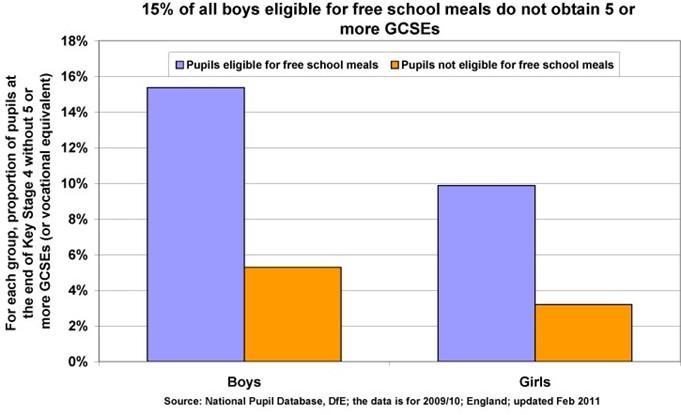
Trend 1: _________________________________________________________________________
Trend 2: _________________________________________________________________________
Task 2: Read the following articles and conduct your own research to write a couple of paragraphs that explains the reasons behind the educational trend regarding social class and achievement. Aim to discuss at least 6 reasons.
- https://www.bbc.co.uk/news/uk-65312086
- https://www.theguardian.com/education/2021/nov/26/children-harmed-by-school-streaming-into-lower-ability-groups-uk-study-shows
- https://news.sky.com/story/children-facing-housing-insecurity-less-likely-to-pass-gcses-research-shows-13336717
- https://www.lboro.ac.uk/news-events/news/2025/february/parents-maths-anxiety-childrens-numeracy-skills/
- https://www.theguardian.com/society/2023/oct/03/warning-unconscious-bias-working-class-pupils-schools-england
- https://www.theguardian.com/education/2017/nov/21/english-class-system-shaped-in-schools
Task 3: For the graph below, identify two trends.
Trend 1: _________________________________________________________________________
Trend 2: _________________________________________________________________________
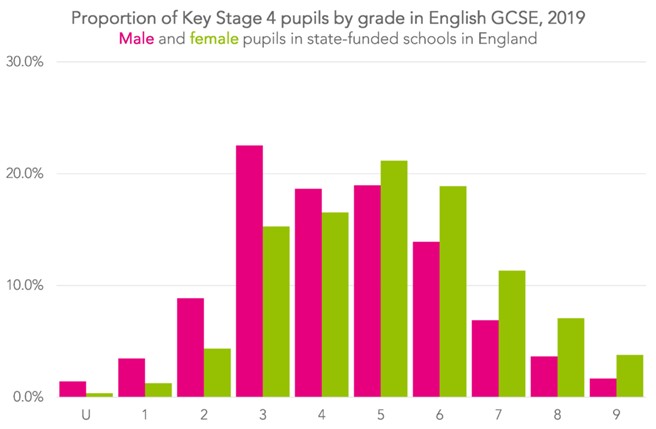
Task 4: Read the articles and watch the following YouTube clips. Conduct your own research to write a couple of paragraphs that explains the reasons behind the educational trend regarding gender and achievement. Aim to discuss at least 6 reasons.
- https://www.theguardian.com/education/2009/aug/27/maths-gcse-coursework-dropped
- https://www.bbc.co.uk/news/education-37552056
- https://www.youtube.com/watch?v=Qdv1CVwRJds&t=85s
- https://www.youtube.com/watch?v=pHoTNPNekYA
- https://www.youtube.com/watch?v=PLce9tGAcuY
- https://literacytrust.org.uk/research-services/research-reports/children-and-young-peoples-reading-engagement-in-2022/
Exam Skills in Sociology: Analysis
Task 1: For the graph below, identify which ethnic group has the highest and lowest achievement.
Note: Attainment 8 is a measure used in England to observe a pupil’s GCSE performance. It’s calculated by averaging a pupil’s highest scores across eight GCSE-level qualifications. Essentially, the closer the score to 90, the stronger the average achievement for that ethnic group is.
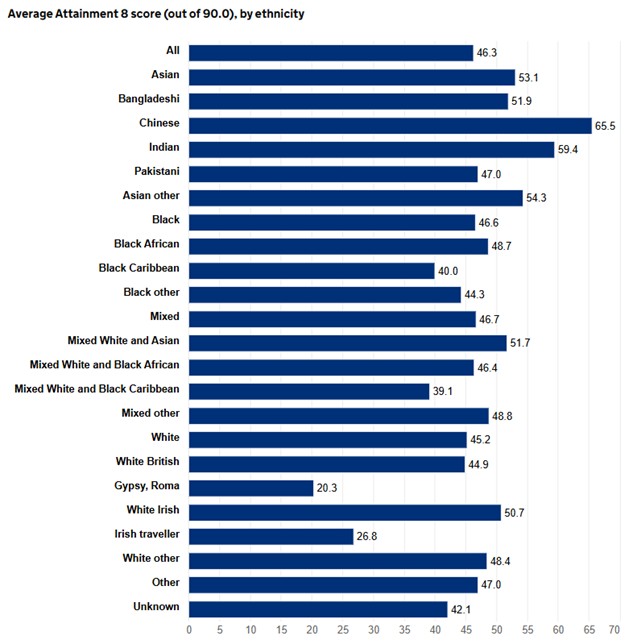
Trend 1: _________________________________________________________________________
Trend 2: _________________________________________________________________________
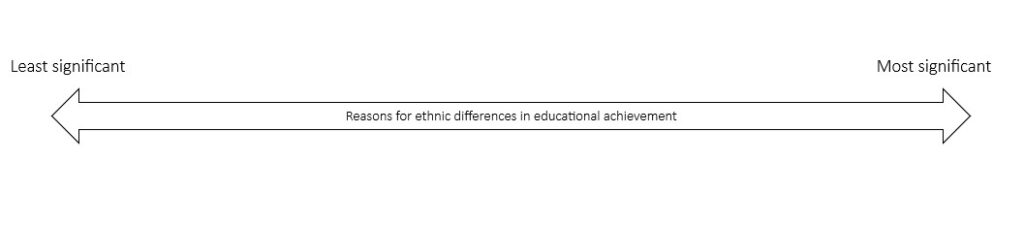
Task 2: Each statement below represents a factor that could explain ethnic differences in achievement. Order the statements onto the line of continuum to identify the level of significance it has on achievement (you will need to draw your own arrow using a ruler). I would recommend just writing the number associated with each statement, rather than writing out the statement in full!
Task 3: Then, you need to annotate three of the statements to justify your decision. Refer to specific ethnic groups, where possible! Explaining in detail why one factor is more or less significant than another is a crucial exam skill – so make sure your justifications are detailed and well-reasoned! You can use your own research on ethnicity and achievement to help you, if you wish.
Statements:
- Language barriers can impact the early educational achievement of ethnic minority pupils who speak English as an additional language.
- Cultural attitudes and values, such as fatalism or present-time orientation, may reduce emphasis on education in some ethnic groups.
- Parental support varies by ethnicity, with some groups like Chinese and Indian families typically placing high value on education.
- Family structure, particularly higher rates of lone-parent households in some groups (e.g., African-Caribbean), may reduce educational support.
- Alignment with school values in some cultures, such as Asian families promoting discipline and hard work, supports academic achievement.
- Material deprivation, including higher poverty rates among ethnic minorities, limits access to educational resources and support.
- Poor housing conditions, such as overcrowding or frequent moves, can disrupt learning and stability.
- Health and diet issues, often linked to poverty, negatively affect concentration, attendance, and academic performance.
- Limited access to resources like the internet, books, or tuition can hinder achievement in some ethnic communities.
- Structural discrimination in housing and employment contributes to long-term disadvantage and educational inequality.
- Institutional racism and social exclusion can lower motivation and belief in the education system.
- Teacher bias and low expectations, especially toward black and Pakistani boys, can lead to underachievement (Gillborn & Youdell).
- Labelling and stereotyping, such as assumptions of African-Caribbean pupils being disruptive, can trigger self-fulfilling prophecies.
- Pupil responses to negative labelling, like forming anti-school subcultures (Sewell), reinforce academic disengagement.
- Peer group influence, particularly among black boys, may discourage academic success due to fear of being labelled as ‘acting white’.
- Curriculum bias, including a Eurocentric focus and lack of cultural representation, can alienate ethnic minority pupils.
- School practices and policies, such as banding, discipline, and uniform rules, may disproportionately affect ethnic minority pupils.
- Systemic bias in assessment and discipline, including “locked-in inequality” (Gillborn), reflects deep-rooted racism in education.
Additional reading: Read the following articles and watch the videos to build your knowledge of ethnic differences in educational acheivement.
- https://www.theguardian.com/education/2021/mar/24/exclusion-rates-black-caribbean-pupils-england
- https://www.theguardian.com/education/2011/feb/07/chinese-children-school-do-well
- https://www.teachfirst.org.uk/blog/racism-uk-schools
- https://www.bbc.co.uk/news/uk-england-leicestershire-57350735
- https://www.jrf.org.uk/deep-poverty-and-destitution/ethnicity-and-the-heightened-risk-of-very-deep-poverty
- https://www.bbc.co.uk/news/education-57558746
- https://www.youtube.com/watch?v=xKP45ZXglvY
- https://www.youtube.com/watch?v=aSH90Fzh1YE
Optional task: If you are interested in learning about Sociology more broadly over the holidays, watch the following recommended documentaries that address many of inequalities that you will study in the A Level Sociology course.
Documentary: Will Britain Ever Have a Black Prime Minister?
Documentary: How to Crack the Class Ceiling, 1/2 with Amol Rajan
Documentary: No More Boys and Girls: Can Our Kids Go Gender Free?
Documentary: Who Gets the Best Jobs?
Additional Resources
We have compiled a reading and watching list for you to stretch your knowledge even further. Please take a look at our recommendations!

Course leader – Sociology