
Hello and welcome to the Economics Department here at Reigate College.
My name is Luisa Pedret and I’m the Head of the Economics Department. Economics is a relevant and challenging subject and I’m really pleased you’ve chosen to study it. I’m looking forward to welcoming you to the department in person at the beginning of the academic year.
Many of you won’t have studied Economics as a separate subject before, so it’s really important you’re fully prepared before you embark on the A Level course. With that in mind, I’d like you to complete a series of tasks and activities over the coming months to introduce you to some of the topics you’ll be studying. You should also aim to read newspapers and journals (many are available for free on-line) to keep up to date with the latest economic developments, especially during these unprecedented times.
The tasks are organised in three distinct steps and should all be completed by Choices Day on 25 August 2026. This is to give you the best insight into what the courses will be like and/or help prepare you for them.
Please note, some Course Leaders (for example for Music) may release their tasks earlier, as they may form part of the College’s audition process. If this applies to you, you’ll be notified separately.
New Starters Course Tasks and Activities
| Release date | Suggested Completion Dates | |
| Explore your Subject | 1 June | 1 July |
| Get Going | 1 June | 1 August |
| Aim High | 1 June | 1 September |
Explore your Subject
Read the article and consider the question: Was the UK right to reduce overseas aid spending to increase defence spending?
Article adapted from https://www.theguardian.com/global-development/2025/feb/28/how-much-does-the-uk-spend-on-overseas-aid-and-where-does-the-money-go
With more spending going to defence, the latest budget cut will take Britain’s aid contribution to its lowest for a quarter of a century
Keir Starmer’s decision this week to slash Britain’s overseas aid budget and divert to defence spending will take UK aid to developing countries to its lowest level in a generation. It will almost halve the already diminished aid pot, from 0.58% of national income to 0.3%. In 2023, the total aid spend was £15.34bn, almost a third of which was spent on supporting and housing refugees and asylum seekers in the UK.
The last time Britain’s aid contribution dropped below 0.3% was a quarter of a century ago, in 1999. Starmer’s move raised concerns among cabinet ministers, who feared it risked reducing soft power and made migration more likely, and outraged humanitarians and aid agencies who warned of a “devastating” impact on the world’s poorest.
It comes after President Donald Trump’s drastic freeze on US Aid spending, prompting warnings that lives would be lost in countries relying on US support.
How has the UK’s overseas budget changed over time?

UK overseas aid has historically risen during Labour governments, most noticeably after Tony Blair came to power in 1997 with a pledge to meet the UN’s target of 0.7% of gross national income. The UN general assembly set the target in 1970 for developed countries to spend 0.7% of gross national income (GNI) on official development assistance (ODA), to promote the economic development and welfare of poorer nations.
The Blair administration, with Gordon Brown as chancellor, set out to reverse a fall in aid spend, from 0.51 in 1979 to 0.27% in 1996, over 18 years of Tory government. Blair set up the Department for International Development (DfID), to focus on reducing poverty, making aid more effective, improving the lives of women and girls and fighting climate change.
Blair committed to achieve 0.7% by 2013. The target was enshrined in law in 2015 and was met every year from 2013 to 2020. Other EU countries committed to the 0.7% target by 2015.
In 2021, at the height of the Covid pandemic, then prime minister Boris Johnson said the economic impacts at home would result in a temporary reduction in ODA spend to 0.5% of GNI. The previous year, Johnson had controversially merged DfID with the Foreign Office.
The Starmer government had committed to restoring the 0.7% spend as soon as fiscal circumstances allowed.
Which countries receive the most aid?

In 2023, official figures show the top three country recipients of bilateral aid were Ukraine (£250m), Ethiopia (£164m) and Afghanistan (£115m). Keir Starmer has said the UK will continue to support Gaza, Ukraine and Sudan, as well as contribute to climate finance and global health.
Regionally, the continent of Africa is the largest regional recipient of UK aid, at £1,229m.
How much does the UK spend on overseas aid annually?
The UK’s ODA spend was £15.34bn in 2023. Based on the most recent forecasts for GNI, reducing aid spend to 0.3% in 2027 would take the budget to £9.2bn.
Almost a third, 28% or £4.3bn, of aid went on support for refugees or asylum seekers in the UK or other donor countries in 2023, a dramatic rise from the 3.2%, or £400m, in 2020.
Britain’s reported costs for each refugee or asylum seeker is many times that of other major European countries, due in part to a shortage of UK accommodation, leading to the Home Office housing people in hotels.
Where does UK aid go?

Humanitarian aid (15.3%) and health (13.3%) were the two largest sectors for bilateral aid in 2023, at £878m and £764m.
Before the pandemic, humanitarian spending was about 15% to 16% of bilateral aid, but was reduced by half in 2021 after the pandemic, to 10.3%, from £1.3bn to £743m.
In 2022 and 2023, the UK provided £592m to humanitarian crises in Ukraine, after the Russian invasion, and £467m to Afghanistan, after the Taliban takeover in 2021. It announced an increase in support for victims of the conflict in Sudan in 2025, to £226.5m.
How does UK aid spend compare internationally?

In 2023, the UK gave the fourth highest aid spend in absolute terms and the ninth highest in terms of percentage of GNI.
Get Going
Studying economics will require you to be aware of current affairs and how they might relate to what is being taught in the classroom. This means undertaking some research.
Task: Tariffs have been placed on various imports into the US by President Trump. Your task is to find 3 articles on this trade war, exploring the following questions:
- What is a tariff?
- What is the purpose of a tariff?
- How do other countries react to these tariffs?
- Who is impacted by a tariff and how?
- Do tariffs benefit Americans?
Sources
The following are a suggested list of sources. You can use others if you wish.
- BBC: https://www.bbc.co.uk/news
- Independent: https://www.independent.co.uk/
- Financial times: https://www.ft.com/
- Guardian: https://www.theguardian.com/uk
- Trading economics: https://tradingeconomics.com/
Bring these articles into your first few lessons, as this will form a basis for discussion. Ensure you take note of where you source your articles.
Aim High
Read the article and answer the questions that follow.
Almost one million young people still not in work or education, figures show
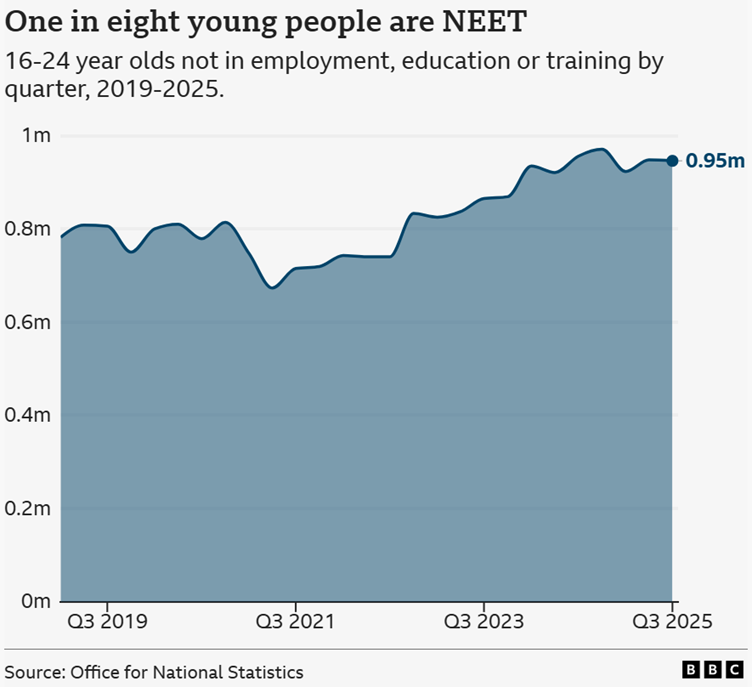
Almost a million young people are still out of work, education or training, new data suggests. The number of so-called Neets – those aged 16-24 who are unemployed or economically inactive in the UK – had fallen slightly to 946,000 between July and September, down from 948,000 in the three months before, according to the Office for National Statistics (ONS). This latest figure equates to one in eight young people.
Announcing a scheme to help young people get access to paid work, education, and apprenticeships, the government said Neet numbers had been “Far too high for too long”.
The numbers of young people who are Neet have been consistently above 900,000 since early 2024 and reached an 11 year high of 987,000 earlier this year. Young people not in employment can be unemployed – which means they are actively seeking work – or defined as economically inactive – meaning they are not seeking work.
The jobs market is particularly challenging for young people, with 2025 figures showing a falling number of vacancies and fewer people on payrolls. The majority of young people (580,000) who are Neet fall into the economically inactive category, compared to 366,000 who are unemployed.
A rise in long-term sickness among young people has been one of the main causes of economic inactivity over the past three years, according to research, external by the Youth Futures Foundation.
Nathan, 21, is currently Neet and is on a six-week employability course in Leeds, run by The Spear Programme, a charity that supports young people across the country by coaching them in communication and interview skills. Working with the charity has helped build his confidence in job interviews, Nathan told the BBC.
“I’ve gone into a good few interviews now, not knowing what to say,” he added. “They [The Spear Programme] help you build your confidence going into interviews, so that you are speaking clearly with a meaning of why you’re there.”
Around half of the charity’s referrals come from the job centre, and all the young people on the course have at least three barriers to work, which could include having been in care, having fewer than five GCSEs or mental health challenges.
Nathan was excluded from five schools as a child, but now he wants to move on and build a future. “You don’t realise between 16 to 21, those ages are when you have to start thinking about what you want to do with your life. The school years matter,” he said. Nathan’s dream is to open his own gym business, and he wants a stable job to help him achieve that. Businesses should do more to take chances on young people, he said.
Historically, more women than men have been Neet, but in recent years that trend has reversed. In July to September 2025, an estimated 512,000 of all male 16-24-year-olds were Neet, compared with 434,000 of young women. In 2023, almost one out of every five (19.5%) young people who were Neet had a mental health condition, according to the Department for Education.
Megan Williams works for The Spear Programme and has worked with Neets for more than 10 years. She says the charity is seeing increasing numbers of young people who are struggling with their mental health and isolation. “A lot of them are struggling to do day to day tasks like get out of bed, get washed, get dressed,” she said. “Engaging with work and education feels very far away for a lot of them.” But employers should take chances on people with less work experience or qualifications because “there are really work-ready motivated young people out there” she said.
In response to today’s figures, the Secretary of State for Work and Pensions Pat McFadden said a planned “Youth Guarantee” scheme would ensure young people “have access to education, training, an apprenticeship – or ultimately guaranteed paid work if they cannot find a job”. McFadden said the government wanted to make sure “every young person has the chance to succeed, no matter where they are from or what their background is”.
Meanwhile, Chancellor Rachel Reeves is expected to lay out more details in the Budget of plans to offer a guaranteed work placement to young people who have been on Universal Credit for 18 months without “earning or learning”. Those who refuse to take part may risk losing benefits. Former Health Secretary Alan Milburn will lead an independent investigation into what is behind the rise in youth inactivity, the department for Work and Pensions recently announced, with a particular focus on the impact of mental health conditions and disability.
The largest quarterly Neets total was recorded in July to September 2011, when the number peaked at over a million after the 2008 financial crisis.
Who are the millions of Britons not working, and why? (Article adapted from https://www.bbc.co.uk/news/business-52660591)
In the Spring Statement, Chancellor Rachel Reeves is announcing a series of measures to cut the welfare bill by making it more difficult for people to claim certain benefits.
The hope is that this will “get Britain working” by incentivising some of those not working to rejoin the labour force.
About a quarter of the working age population – those aged 16 to 64 – do not currently have a job. That’s about 11 million people.
How many people are unemployed?
According to the latest figures from the Office for National Statistics (ONS), 4.4% of people were unemployed in the period between October and December 2024, which is about 1.6 million people.
While this figure has risen over the past two years, unemployment remains relatively low by historical standards.

However, unemployed people represent only a small part of the nearly 11 million working-age people who don’t have a paid job.
About 9.4 million of them are not called “unemployed”. That is because they are not actively looking for work, or available to start a job.
Instead people in this group are called “economically inactive”
But 1.6 million of that group – in addition to the unemployed – do say they want a job.
The number of vacancies, is currently just 0.8 million – that has been falling consistently for the past two years, with a slight uptick in the latest figures.
Who isn’t working – and why?
It varies according to age.
ONS figures for October 2023 – September 2024 show that most of the 2.8 million “inactive” under-25s were students. The majority of them did not want a job. Among 25- to 49-year-olds, nearly 1.1 million people did not work because of caring responsibilities, nearly a million of whom were women. Over one million people in this age group were not working because of illness.

The main reasons that 3.5 million over-50s were out of the job market were illness and early retirement. Very few of those who retired early said they wanted to return to work.
Around half of people with disabilities, did not have a paid job, a rate that is more than double the rest of the working-age population. Less than a quarter of all those who were sick or caring said they wanted a job.
Does it matter that people aren’t looking for work?
Many people are not looking for work because they are studying, caring or have retired.
Some people want to work but cannot, either because childcare is too expensive or they are not well enough. As the chart below shows, caring responsibilities and ill-health are the most common reasons for inactivity given by those who would like a paid job. The number of people not working has a broader effect.

A smaller workforce means the government raises less income tax and National Insurance, which it uses to pay for services like the NHS.
It may also spend more on benefits. Since people on benefits generally have less money than those in work, it also means less spending on the High Street.
That in turn is bad for businesses, and can affect how many people they employ, which can mean there are fewer jobs for those who do want to work.
How does the UK compare with other countries?
During the Covid pandemic, all major countries saw their workforce shrink. But while many other leading economies have since recovered, the UK still has more people out of its workforce than it did in 2019. There is a debate about how much of this is down to problems with how we work out how many people are inactive.
Before Covid, the UK’s “inactivity rate” was the second lowest in the G7 club of leading economies, behind Japan. The increase in the inactive population since then means that now the UK has a higher inactivity rate than Japan, Canada, and Germany.
The independent Office for Budget Responsibility, – which assesses how well the UK economy is doing – has suggested that ill-health has consistently been a bigger factor in the UK than in other advanced economies.
What is the government doing to get more people into work?
Last week, the Work and Pensions Secretary Liz Kendall unveiled a series of welfare reforms that would make it harder for people with less severe conditions to claim disability payments. The stricter tests for personal independence payments (PIP) are expected to affect hundreds of thousands of claimants.
Extra benefit payments for health conditions will also be frozen for current claimants and nearly halved for new applicants while people aged under 22 could be prevented from claiming Universal Credit (UC) top-up payments for health conditions.
In her Spring Statement, Chancellor Rachel Reeves added that health-related UC will also be frozen until 2030. This is all in addition to the November plans, announced by Prime Minister Sir Keir Starmer to get two million more people into work.
The proposals included:
- overhauling the health and disability benefits system to better support people to get jobs and stay in work
- rebranding job centres as the National Jobs and Careers Service
- offering every 18 to 21-year-old in England an apprenticeship, training or education opportunities or help to find a job as part of a new “Youth Guarantee”
- an independent review of what UK employers are doing to promote health and inclusive workplaces
- providing more money for the North East, South Yorkshire and West Yorkshire to stop people leaving work because of ill health
- expanding mental-health support and efforts to tackle obesity.
The proposals followed widespread criticism from businesses that the increase in National Insurance announced in the Budget, coupled with the rise in the minimum wage, will make it harder for them to create new jobs. Companies warn this will undermine the government’s goal of increasing the working population.
Task:
Answer the following questions, bringing your answers with you to your first lesson. A sensible amount to write is given in brackets after each question.
- What are the differences between being unemployed and being economically inactive? (a couple of sentences for each, including examples)
- How does higher levels of unemployment and economic inactivity impact the overall economy and individual households? (3 impacts, a few sentences on each)
- What roles do education and healthcare play in reducing unemployment and economic inactivity?
- How might government policies influence the unemployment rate and economic inactivity?
- What initiatives or programs could the government implement to reduce the level of economic inactivity?

Head of Economics