College supported me throughout my A Level studies, while also fostering the confidence and independence that were key to hitting the ground running at university. I found the Aspire programme particularly useful and I think it’s one of the College’s biggest strengths. It taught me to seize opportunities as they appear, despite the challenges that might present themselves (like the start of a global pandemic!). I was incredibly lucky to be taught by enthusiastic teachers who always went above and beyond. This was especially true of my amazing Physics teacher, Nicky, who supported and believed in me throughout the slightly stressful Oxbridge application process.
My time at College ended rather abruptly, with A Level exams cancelled due to COVID-19. It was a strange time, but it felt particularly weird starting university a few months later with mask-wearing and social-distancing in full swing. I chose to study Physics because I liked the combination of maths and science it offered, and I had a great time picking apart the mechanics of the universe during my time at Oxford. As things began to open back up, I was glad that I pushed myself to study during lockdown as it allowed a more relaxed final couple of years to explore the city and meet people properly.
I was enjoying the programming aspects of my course the most, so I then chose to stay on at Oxford for a computational Master’s project with a cool theme: using satellites to detect volcanic plumes.
After graduating from the University of Oxford, I’ve taken this theme further, by studying for a PhD in atmospheric science at the University of Leeds. Within my research, I use satellite data and chemical transport models to monitor wildfire emissions globally. I didn’t go into my degree thinking I’d go on to do a PhD, but I enjoyed my master’s project and was introduced to lots of interesting areas of research. It’s worth prioritising something you enjoy and see where it takes you, which is basically what I did when applying for my PhD.
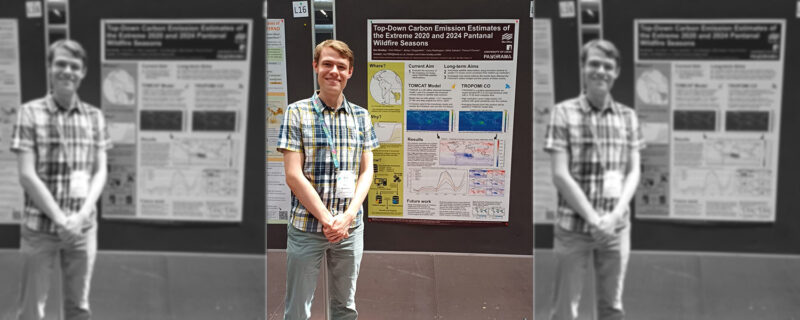
My current work aims to better understand wildfires and their carbon emissions by combining satellite observations of wildfire plumes with inversion modelling to track the plumes back to their source. Researching something with a strong positive impact like this keeps me motivated and excited by my work – even when my model is spitting out horrible errors! I’ve already travelled across the UK and internationally to present some early results and I’m looking forward to publishing my first academic paper in the not-too-distant future!
Ben Bradley
Reigate College: 2018-2020
Higher Education: MPhys, University of Oxford (Keble College)
Currently: PhD Atmospheric Science, University of Leeds